Quick answer: A regulation tennis court is 78 ft (23.77 m) long and 27 ft (8.23 m) wide for singles or 36 ft (10.97 m) wide for doubles. The net stands 3 ft 6 in (1.07 m) at the posts and 3 ft (0.914 m) at the center. The lined playing surface is identical at every level of the sport. What changes between a backyard court and Centre Court Wimbledon is the run-off: the cleared space around the lines, which expands the total court footprint from roughly 6,400 sq ft at home to over 9,100 sq ft on a Grand Slam show court.
When people think about tennis court dimensions, they usually think about the lines: how long the court is, how high the net sits, where the service boxes start. Those numbers are codified down to the inch in the ITF Rules of Tennis, and they have not changed in any meaningful way since the late nineteenth century.
What surprises most casual players is the second set of dimensions: the run-off. Pro tennis happens on a court that is more than three times the footprint of the lines you see on TV. A backyard court fits inside a 114 by 56 foot rectangle. Arthur Ashe Stadium plays out on a 130 by 70 foot envelope, and that is before you account for the seats, the cameras, the chair umpire, and the line judges.
This is the complete guide to both: the lines and the empty space around them.
The Numbers Every Player Should Know
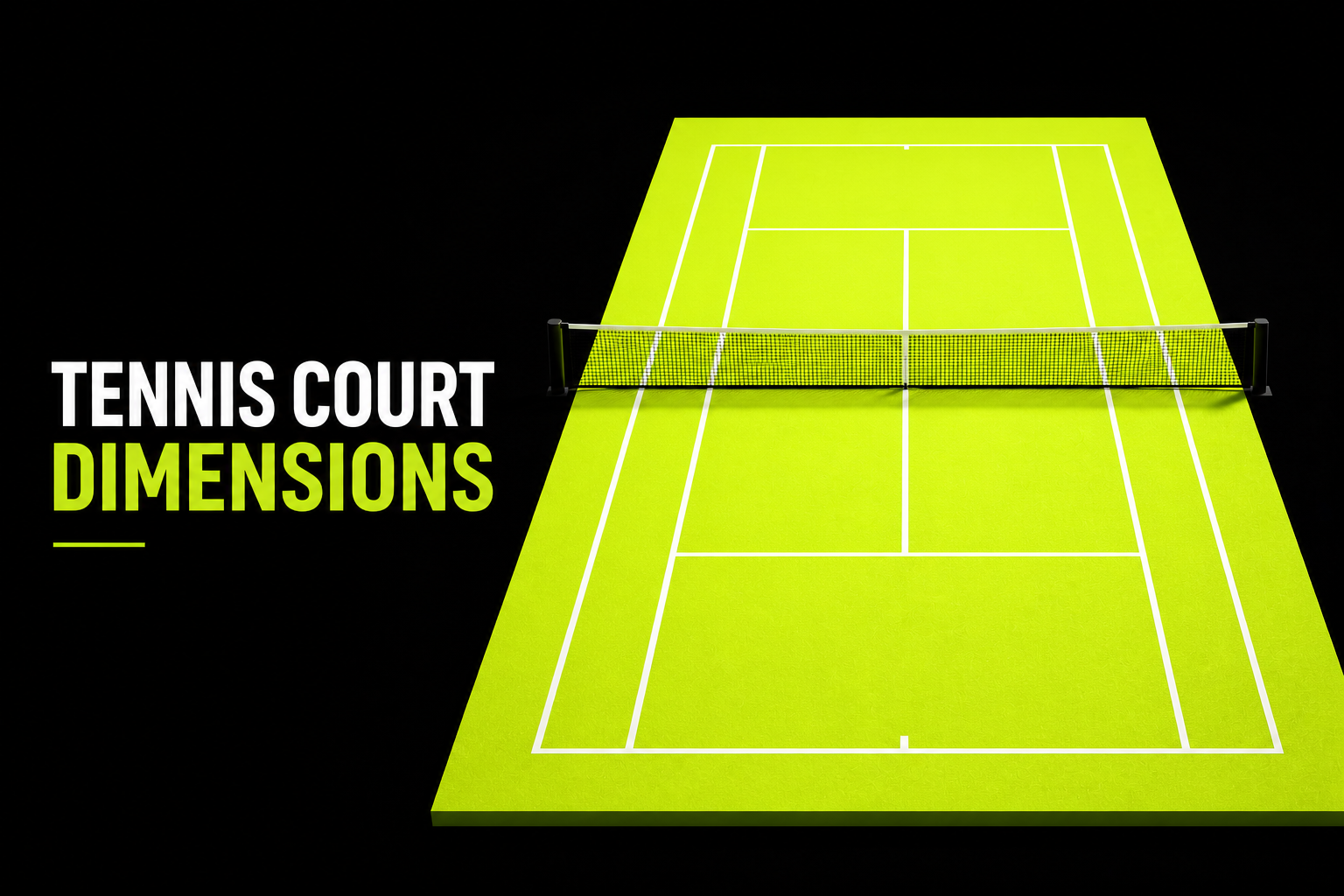
The court itself, between the lines, is identical at every level of tennis. From a public hard court in Queens to Court Philippe-Chatrier in Paris, the painted rectangle is the same size, set per ITF Rule 1: "The Court shall be a rectangle 78 feet (23.77 m) long and 27 feet (8.23 m) wide."
| Dimension | Imperial | Metric |
|---|---|---|
| Total court length (baseline to baseline) | 78 ft 0 in | 23.77 m |
| Singles court width (sideline to sideline) | 27 ft 0 in | 8.23 m |
| Doubles court width (outer sideline to outer sideline) | 36 ft 0 in | 10.97 m |
| Doubles alley (each side) | 4 ft 6 in | 1.37 m |
| Net height at posts | 3 ft 6 in | 1.07 m |
| Net height at center | 3 ft 0 in | 0.914 m |
| Service line distance from net | 21 ft 0 in | 6.40 m |
| Baseline to service line | 18 ft 0 in | 5.49 m |
| Service box (each) | 21 ft x 13 ft 6 in | 6.40 m x 4.115 m |
| Center mark length | 4 in | 10 cm |
| Center mark and center service line width | 2 in | 5 cm |
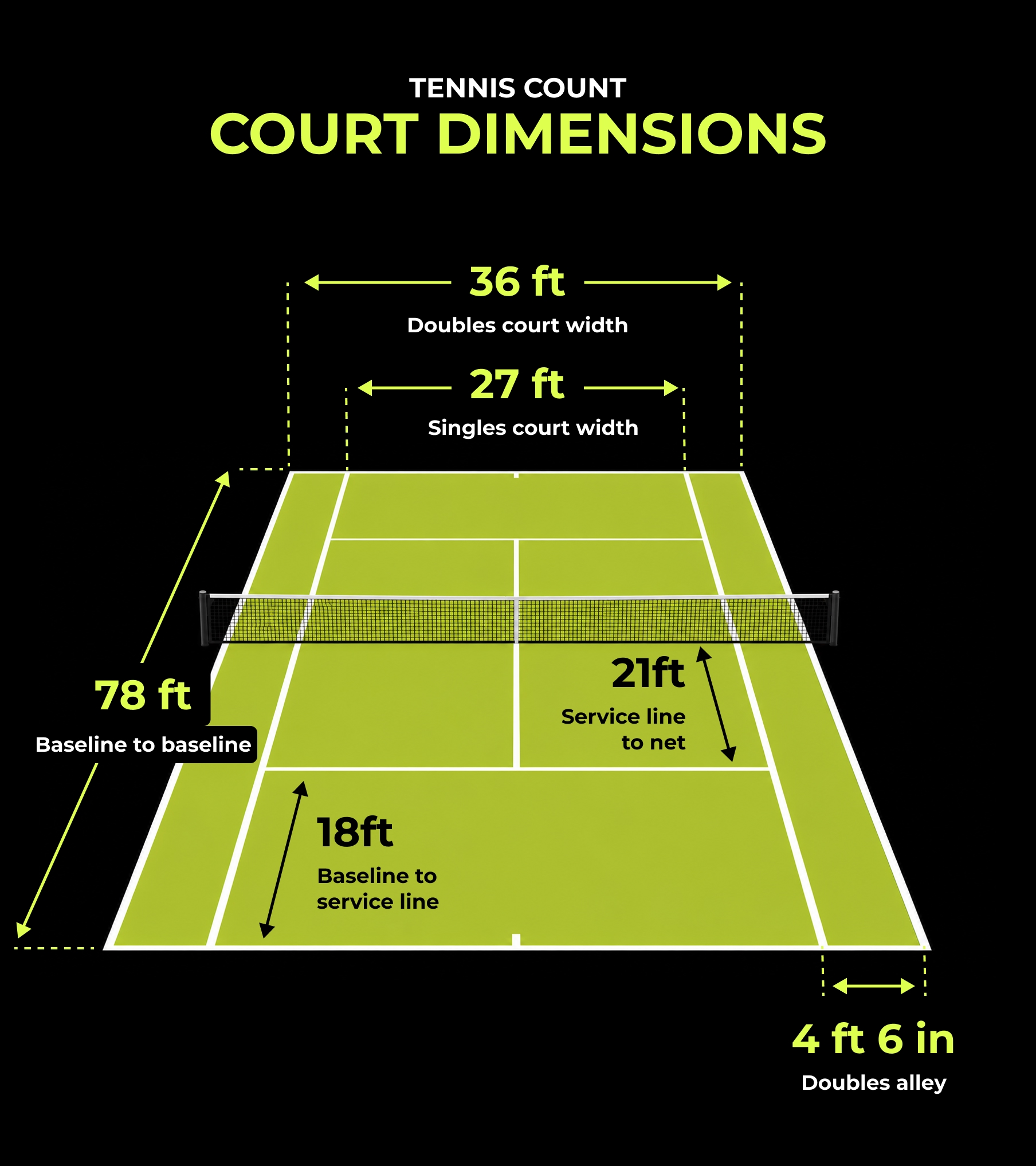 Original diagram by Tennis Count. Curated from ITF Rule 1 and USTA court layout documentation.
All measurements are taken to the outside of the lines (ITF Rule 1). The total area of the lined doubles court is 2,808 sq ft (260.87 sq m), calculated as 78 ft x 36 ft.
Singles vs Doubles: Same Court, Different Lines
A doubles court and a singles court occupy the same painted rectangle. The only difference is which sidelines are in play.
In singles, the inner sidelines (the singles sidelines) define the boundary. The two strips outside them, called the doubles alleys or tramlines, are out of bounds. Each alley is 4 ft 6 in (1.37 m) wide. The court plays at 27 ft (8.23 m) wide.
In doubles, the outer sidelines (the doubles sidelines) define the boundary. The court plays at 36 ft (10.97 m) wide, exactly 9 ft (2.74 m) wider than singles, with that extra space split evenly across both sides.
The service boxes are identical in both formats. They are bounded by the singles sideline, the center service line, the net, and the service line. The doubles alley is never part of the service box (ITF Rule 34). A serve that lands in the doubles alley is a fault, in both singles and doubles.
Singles Sticks: The Most Misunderstood Pieces of Equipment
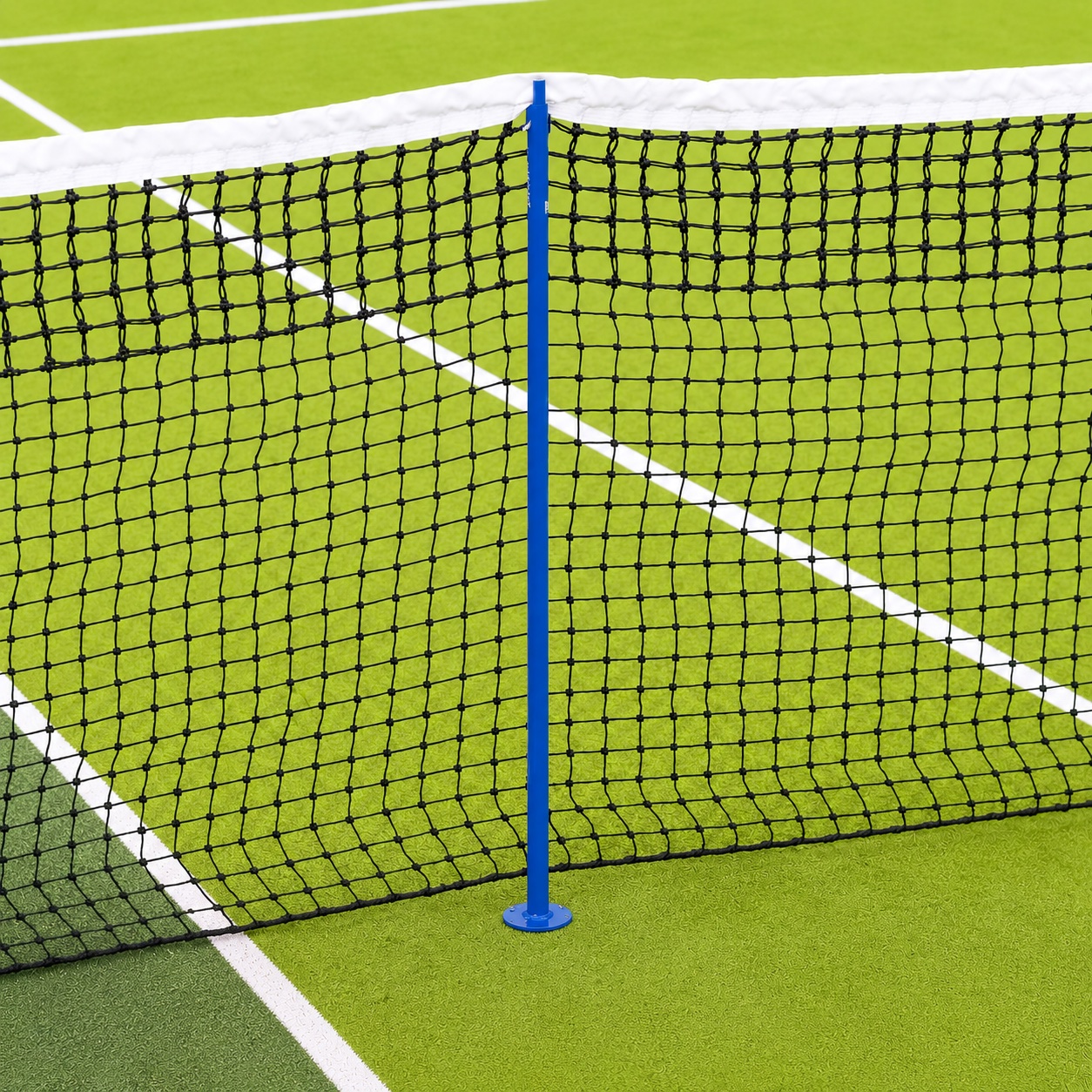 A singles stick in position. Per ITF Rule 1, the stick must be no more than 3 in (7.5 cm) square or in diameter and must hold the net at 3 ft 6 in (1.07 m) at a point 3 ft (0.914 m) outside the singles sideline.
When singles is played on a court set up with a doubles-width net, the net sags lower than the regulation 3 ft 6 in (1.07 m) over the singles sidelines, because the posts are stationed 3 ft (0.914 m) outside the doubles sideline, which is 7 ft 6 in (2.29 m) outside the singles sideline.
Per ITF Rule 1, when this happens you are required to use singles sticks ("called 'singles sticks', which shall be not more than 3 inches (7.5 cm) square or 3 inches (7.5 cm) in diameter"). These prop the net up at the singles sideline so the net height over the singles court remains 3 ft 6 in. The centers of the singles sticks must sit 3 ft (0.914 m) outside the singles sideline.
In practice, you will rarely see singles sticks on a public court. Recreational matches play with the natural sag in the net. At any officiated singles match, the singles sticks are non-negotiable.
The Net (Deeper Dive)
The 6 inch dip from post (3 ft 6 in) to center (3 ft) is no accident. The lower center makes attacking down the middle a viable tactic without giving short balls a free pass.
| Net spec | Imperial | Metric | Source |
|---|---|---|---|
| Height at posts | 3 ft 6 in | 1.07 m | ITF Rule 1 |
| Height at center (held by strap) | 3 ft 0 in | 0.914 m | ITF Rule 1 |
| Strap width (white, holds center down) | up to 2 in | up to 5 cm | ITF Rule 1 |
| Band on top (white, covers cord) | 2 in to 2.5 in | 5 cm to 6.35 cm | ITF Rule 1 |
| Net cord or cable diameter | up to 1/3 in | up to 0.8 cm | ITF Rule 1 |
| Net post (square or round) | up to 6 in | up to 15 cm | ITF Rule 1 |
| Net post position (from doubles sideline) | 3 ft (0.914 m) outside | same | ITF Rule 1 |
| Total net width (post to post on a doubles court) | approx. 42 ft | approx. 12.80 m | derived (36 + 3 + 3) |
The mesh openings have to be small enough that a ball cannot pass through. In practice, that puts ITF-compliant nets between roughly 1.75 in and 1.875 in (4.45 cm to 4.76 cm).
The USTA-published procedure for setting net height: loosen the center strap, tighten the cord until the center sits at about 40 inches above the ground, then tighten the strap until the center reaches exactly 36 inches.
Service Boxes and Lines
Service boxes are 21 ft x 13.5 ft (6.40 m x 4.115 m). Each box is bounded by the net, the service line, the singles sideline, and the center service line. The service line sits 21 ft (6.40 m) from the net and 18 ft (5.49 m) from the baseline.
The center service line runs the full distance from net to service line, exactly halfway between the singles sidelines, and must be 2 in (5 cm) wide.
Each baseline is bisected by a small painted center mark, 4 in (10 cm) long and 2 in (5 cm) wide, drawn inside the court at right angles to the baseline (ITF Rule 1). The mark extends from the imaginary continuation of the center service line. Servers must stand on the correct side of this mark.
Line Widths
Per ITF Rule 1:
- All lines: minimum 1 in (2.5 cm), maximum 2 in (5 cm) wide.
- The baseline may be wider, up to 4 in (10 cm).
- The center service line and center mark are exactly 2 in (5 cm).
- All measurements are made to the outside of the lines.
- All lines must be of uniform color and contrast clearly with the court surface.
This is why baselines look noticeably thicker than the rest of the markings on most courts: the rule allows it, and it improves baseline call accuracy from across the court.
The Padding: Why Tournament Courts Are 3x Bigger
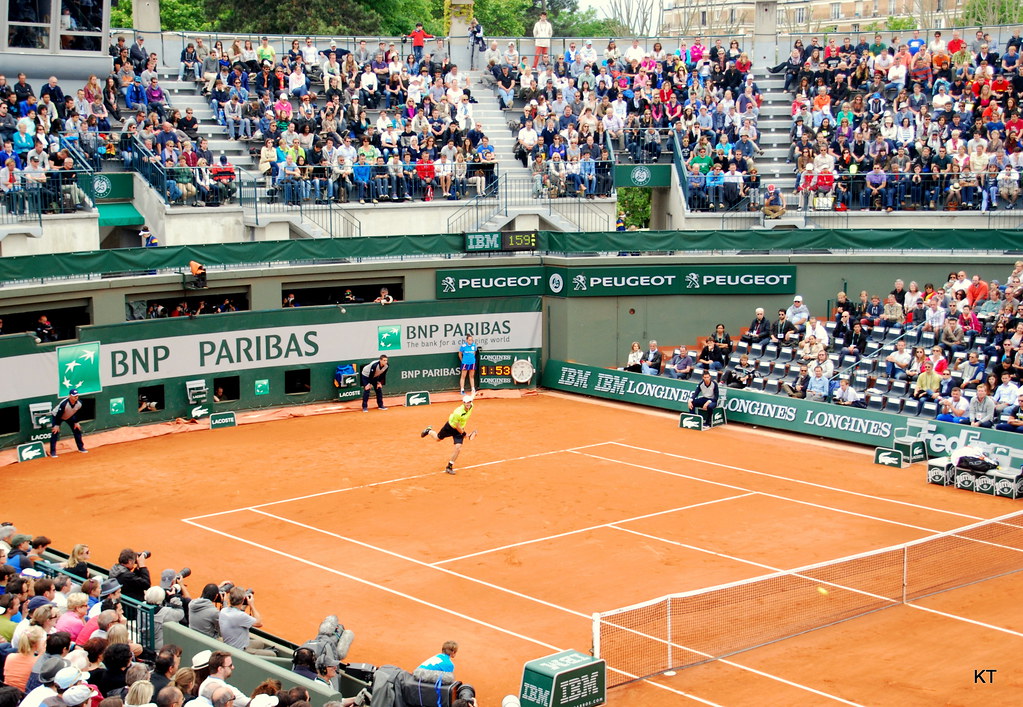 Andy Murray at Roland Garros, Court 1, 2014. Notice how much cleared space sits behind the baseline and beside the sideline, far more than any public court. Photo by Carine06, CC BY-SA 2.0.
This is the section that changes how you watch tennis on TV.
The lined playing surface is identical everywhere. What changes dramatically as you climb from a backyard court to a Grand Slam show court is the run-off, also called run-back, clearance, overrun, or court envelope. Players need room to chase deep balls and slide for wide returns. At the pro level there is also space for the chair umpire, line judges, ball kids, photographers, and TV cameras.
Run-off is set in the ITF Rules of Tennis (recommended minimums in Note 2 of Rule 1) and the joint USTA / ASBA "Tennis Courts: A Construction & Maintenance Manual" (ASBA Construction Guidelines). The numbers below come from those documents, plus the ATP Tour Rulebook, Chapter VI.
| Tier | Back run-off (per end) | Side run-off (per side) | Total court envelope (L x W) | Total area | Multiple of lined court |
|---|---|---|---|---|---|
| Residential / minimum playable | 18 ft (5.49 m) | 10 ft (3.05 m) | 114 ft x 56 ft (34.75 m x 17.07 m) | 6,384 sq ft | 2.27x |
| Standard public / club (USTA non-tournament) | 18 ft (5.49 m) | 12 ft (3.66 m) | 114 ft x 60 ft (34.75 m x 18.29 m) | 6,840 sq ft | 2.44x |
| USTA / ITF tournament minimum | 21 ft (6.40 m) | 12 ft (3.66 m) | 120 ft x 60 ft (36.58 m x 18.29 m) | 7,200 sq ft | 2.56x |
| ATP / WTA tour event (typical outside court) | 24 to 27 ft (7.32 to 8.23 m) | approx. 15 ft (4.57 m) | approx. 126-132 ft x 66 ft | approx. 8,300 to 8,700 sq ft | approx. 3.0x |
| Grand Slam / Davis Cup show court | 27 ft (8.23 m) plus officials zone | 18 ft (5.49 m) | 130 ft x 70 ft (39.62 m x 21.34 m) | 9,100 sq ft (845 sq m) | 3.24x |
| Adjacent courts in a battery | n/a | min 12 ft (3.66 m), recommended 24 ft (7.32 m) | n/a | n/a | n/a |
A Grand Slam show court therefore occupies more than three times the footprint of the lined playing surface, and roughly 42% more total area than a code-compliant residential court. Going from residential to Grand Slam adds 9 ft of length at each end (50% more back run-off) and 8 ft on each sideline (80% more side run-off), turning a 6,384 sq ft footprint into 9,100 sq ft.
This is the single biggest reason the pros' court looks so much larger than yours. The lines are the same. The breathing room is not.
What the Manual Says, Verbatim
From the ASBA / USTC&TBA Construction Guidelines, Section II.B (Tennis Court Dimensions and Related Measurements):
Back Space: Tournament play requires a minimum 21' (6.401 m) from base line to fixed obstruction (i.e. backstop, wall, etc.). In non-tournament play, this distance may be reduced to 18' (5.486 m).
Side Space: Not less than 12' (3.658 m) is required from the side line to a fixed obstruction (i.e. sidestop, light pole, wall, etc.).
Clearance Between Courts: Where courts are constructed within the confines of a common enclosure, the distance between side lines should be not less than 12' (3.658 m). Where space permits, it is desirable to provide additional space between side lines to enhance play; 24' (7.315 m) is recommended.
If you have ever wondered why doubles play feels cramped at a public park (or why a forehand into the corner has nowhere to run out), this is the answer. Most US public facilities only meet the 12 ft minimum between courts, half the recommended figure.
The Grand Slam Show Courts
The four Grand Slam main courts all play on the same 78 ft x 36 ft lined surface. Each one expands that into the 130 ft x 70 ft show-court envelope, plus seating, broadcast infrastructure, and (now) retractable roofs.
- Arthur Ashe Stadium at the USTA Billie Jean King National Tennis Center (US Open, Flushing Meadows). Hard court (DecoTurf, now Laykold). Largest tennis stadium in the world by capacity. Retractable roof installed for the 2016 tournament.
- Centre Court at the All England Lawn Tennis Club (Wimbledon, London). Grass court (perennial ryegrass). Retractable roof installed for the 2009 Championships.
- Court Philippe-Chatrier at Roland-Garros (French Open, Paris). Red clay (crushed brick). Retractable roof installed for the 2020 tournament.
- Rod Laver Arena at Melbourne Park (Australian Open). Hard court (Plexicushion, now GreenSet). Retractable roof installed in 1988, the first Grand Slam venue with one.
What is identical across all four: the painted rectangle, the net height, the service-box dimensions, the line widths. What varies is everything around the lines.
Beyond Dimensions: Lighting, Slope, Orientation
Court dimensions are not the only thing the rule book and construction guides regulate.
Lighting (USTA / IES RP-6)
The Illuminating Engineering Society and USTA classify play by level. Foot-candle minimums are measured on the principal playing area, at the surface (USTA standards summary).
| Class | Use case | Average maintained foot-candles | Lux equivalent |
|---|---|---|---|
| Class I | Professional, televised | 125 fc | approx. 1,345 lux |
| Class II | College, Challenger | 75 to 100 fc | approx. 800 to 1,075 lux |
| Class III | Club, high school | 50 to 75 fc | approx. 540 to 800 lux |
| Class IV | Recreational | 30 to 50 fc | approx. 320 to 540 lux |
Broadcast lighting at Grand Slams runs about 285 fc (approx. 3,067 lux), more than double the Class I floor. Uniformity ratios (max:min) are tighter at higher levels: 1.5:1 for Class I and II, 2.0:1 for Class III and IV.
Court Orientation
The long axis of an outdoor court should run roughly north to south so morning and evening sun does not shine straight down the court at the server. The American Sports Builders Association recommends orienting perpendicular to the average solar azimuth during peak-use months. Many US facilities rotate the court a few degrees west of true north to keep the late-afternoon sun off the southwest baseline (ASBA Section 2.A).
Surface Drainage Slope
Outdoor courts have to shed water somewhere. Per ASBA construction guidelines:
- Hard courts: 1 in per 10 ft (about 0.83% to 1.0%, written as 1:120 to 1:100). Minimum 1 in per 15 ft (0.56%).
- Clay or fast-dry courts: 1 in per 30 ft (0.28%) minimum, 1 in per 24 ft (0.35%) maximum.
- Direction: Single plane only. Side-to-side, end-to-end, or corner-to-corner. Never crowned. Never net-to-baseline. Never sides-to-center.
Surface Tolerances
For an asphalt hard court, ASBA Section 2.I requires the finished playing surface not vary more than 1/8 inch in 10 ft (3 mm in 3 m) when measured in any direction with a 10 ft straightedge. The intermediate pavement course tolerance is 1/4 inch in 10 ft.
Fence and Backstop
Standard chain-link fence height is 10 ft (3.05 m) for full enclosure or end backstops, with 12 ft (3.66 m) common for tournament venues. Clay courts often run lower, at 8 ft (2.44 m), since ball bounce is lower on the surface. Tennis fence systems typically conform to ASTM F969, the standard for chain-link installations.
Why It Matters
When you stand at the baseline of a public court and feel like the back fence is too close, that is not your imagination. Most US public facilities are built to USTA non-tournament minimums (18 ft of back run-off, 12 ft of side run-off). Many older facilities and almost every backyard court were built to less.
A 9 ft difference in back run-off is the difference between casually retrieving a deep lob and crashing into the fence. An 8 ft difference between sidelines and the side wall is the difference between sliding into a passing shot and pulling up to avoid a collision. The pros do not just have better strokes. They have a court built for the strokes they want to play.
The good news: the lines are the same. Your forehand crosses the same 36 ft width as Carlos Alcaraz's. The center service line is the same 2 inches wide. The net dips to the same 3 ft at the center. Every painted line you played on this morning is identical to the one Centre Court Wimbledon will use for the 2026 final.
The empty space around the lines is where the gap shows up.
Find Tennis Courts in Your City
Ready to play? Browse popular tennis cities:
New York · Los Angeles · Chicago · San Diego · Washington DC · San Francisco · Houston · Miami
Or browse all tennis courts by state.
Sources
Primary rule books and construction guides
- ITF Rules of Tennis 2026 (PDF). Rule 1 (the court, lines, net, posts), Rule 34 (the doubles court), Appendix IX (plan of the court).
- ITF Rules of Tennis with USTA Comments (PDF mirror). Full text including USTA Comments 1.1 (net tightening procedure) and 1.2 (singles sticks).
- ITF Rules and Regulations. Governance documents.
- USTA 78 Foot Court Layout (PDF). Canonical lined-court drawing.
- USTA Tennis Court Design Considerations (PDF). Facility planning notes.
- ASBA / USTC&TBA Tennis Court Construction Guidelines (PDF). Section II.B verbatim quotations on back space, side space, and clearance between courts.
- ASBA Tennis Construction Guidelines (publisher index).
- ASBA Section 2.A (Court Orientation).
- ASBA Section 2.B (Dimensions).
- ASBA Section 2.I (Hot Mix Asphalt Tennis Courts, planarity and slope).
- ATP Tour 2025 Official Rulebook, Chapter VI (Facilities & On-Site Conditions).
Lighting standards
- Sport Light Supply: IES & USTA Tennis Court Lighting Standards.
- HomElectrical: Tennis Court Lighting Standards (recreational to professional).
Cross-references and supplementary reading
- Wikipedia: Tennis court. Overview of dimensions and clearance.
- Tennis Department: Tennis Court Dimensions.
- Harrod Sport: Tennis Court Dimensions.
- My Tennis Expert: Tennis Court Dimensions.
- Courtslytics: Tennis Court Dimensions.
- Hoover Fence: Chain Link Tennis Court Installation (ASTM F969).
- Hybrid Clay: Tennis Construction Regulations USA.
- All Star Tennis Supply: Tennis Net Measurement Regulations.
- Tennis Planet: Professional's Guide to Official Tennis Court Dimensions.
Written by the team at Tennis Count, a free court discovery platform built by tennis and pickleball players for tennis and pickleball players. We write from firsthand playing experience to help you find the best courts and make the most of your time on them.