Tennis is one of the few sports you can pick up at any age and play for the rest of your life. Unlike most team sports, you need almost nothing to get started — a racket, a ball, a court, and one other person. Within a few sessions you'll be rallying. Within a few months, you'll be hooked.
This guide covers everything a complete beginner needs to know: equipment, the rules, how scoring actually works, the basic strokes, and what to expect on your first day out. No prior experience required.
Why Tennis Is a Great Sport for Beginners
Tennis has a low barrier to entry compared to how much it gives back. Here's why it's worth starting:
It's a lifetime sport. Unlike contact sports that accumulate injury, tennis is played at every level well into your seventies and eighties. The USTA runs age group divisions all the way up to 85+. You're not just learning a hobby — you're investing in decades of play.
The health benefits are substantial. A 2017 study in the British Journal of Sports Medicine tracking 80,000 adults found that racket sports were associated with a 47% lower risk of cardiovascular mortality — higher than any other sport studied. A singles match burns roughly 400–600 calories per hour depending on intensity and body weight. More practically, tennis combines aerobic conditioning, lateral agility, hand-eye coordination, and strategic thinking in a way that pure cardio workouts don't.
You don't need to be athletic to start. The beginner game is mostly about getting the ball over the net and keeping it in the court. Footwork and power develop over time. Many players who start as total novices are competitive within a year.
The social structure is built in. Tennis has a ready-made community. Public courts, club ladders, USTA leagues, and open social play nights mean you will always find people to play with once you know the basics.
Essential Equipment
You don't need to spend a lot to start. Here's what you actually need and what to look for.
The Racket
Your racket is the only piece of equipment that meaningfully affects how you play, so it's worth thinking about — but not overthinking.
- Head size: Beginners should look for a head size between 100–110 square inches. A larger head gives you a bigger sweet spot, which means more forgiveness on off-center hits. Tour players often use smaller heads (95–100 sq in) because they prioritize control, but that tradeoff doesn't help you yet.
- Weight: Lighter rackets (9–10 oz / 255–285g) are easier to swing quickly and put less strain on your arm. Most beginner rackets fall in this range. Avoid anything marketed as "ultra-light" (under 9 oz), which can feel unstable.
- Grip size: Hold the racket with your dominant hand. There should be roughly one finger's width of space between your fingertips and your palm. Too small a grip causes the racket to twist; too large makes it hard to flick the wrist through the ball. Common sizes run from 4 to 4 5/8 inches, with 4 1/4 and 4 3/8 suiting most adults.
- Price range: A decent beginner racket costs $50–$100. Brands like Wilson, Head, Babolat, and Yonex all make solid entry-level options. Avoid the $20 rackets at big-box stores — they're strung too loosely and won't last.
Balls
Standard tennis balls come in pressurized cans. Buy a can of three to start — they'll last a few sessions before going flat. Extra duty balls are for hard courts; regular duty are for clay and indoor surfaces. For casual beginner play, either works fine.
Tip: If you're struggling to get rallies going, consider low-compression balls (labeled "Stage 1" or red/orange/green dot balls). These bounce lower and slower, which makes them significantly easier to rally with. Many adult beginner programs use them, and they accelerate learning considerably.
Shoes
Do not play tennis in running shoes. Running shoes are built for forward motion; tennis requires constant lateral cuts and quick direction changes. Playing in running shoes risks rolled ankles and offers no support for the side-to-side stress the sport puts on your feet.
Tennis shoes have reinforced lateral support and a flatter, more stable sole. A basic pair from Nike, Adidas, New Balance, or Asics runs $60–$100. Check that the shoe is specifically labeled for tennis, not just "court" or "athletic."
Clothing
Any athletic wear works for recreational play. Most tennis clothing is simply light, moisture-wicking fabric that allows free arm movement. Some clubs and tournaments have dress codes (Wimbledon famously requires all-white), but you won't encounter that as a beginner at a public court.
Understanding the Court
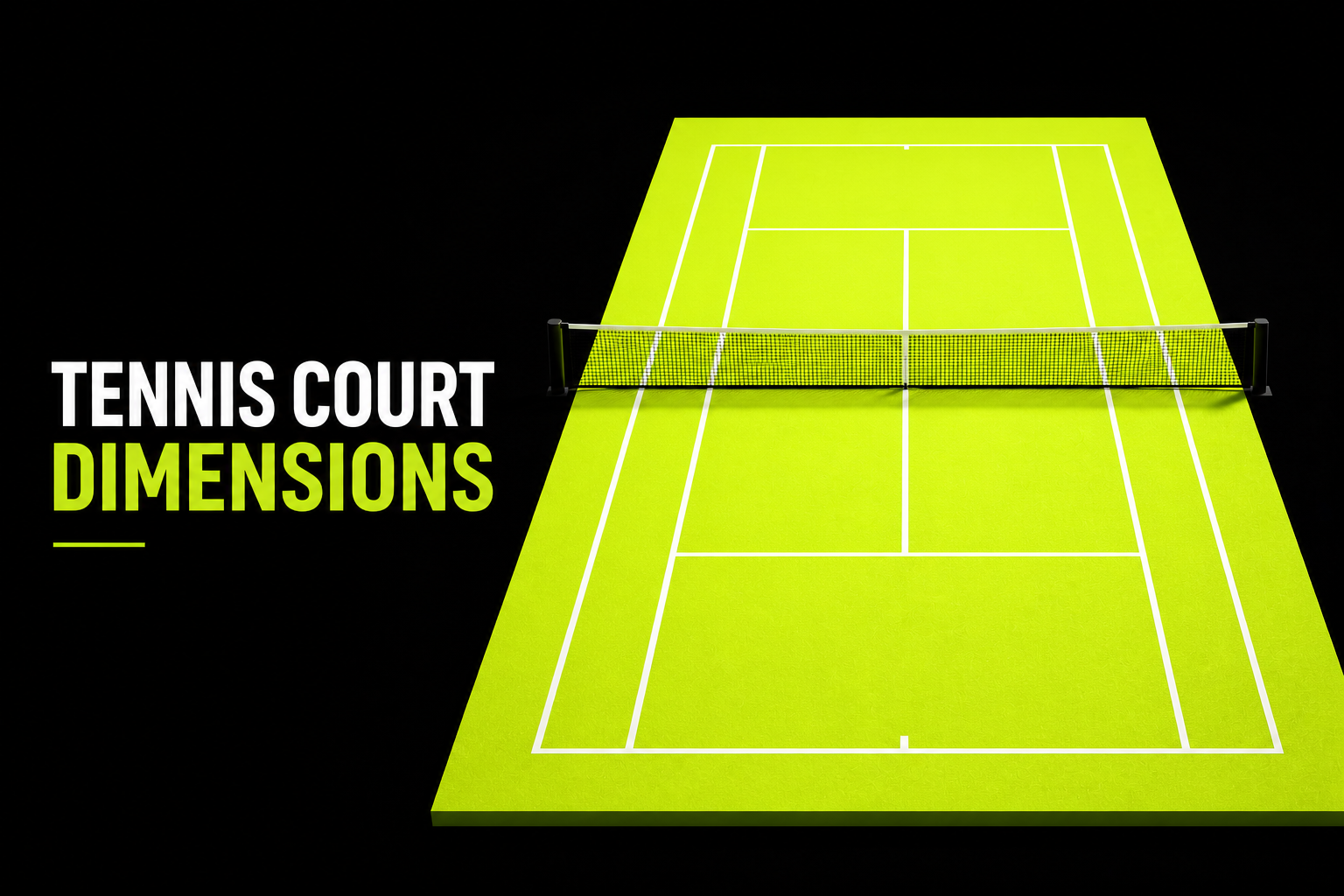
A standard tennis court is a rectangle 78 feet long and 36 feet wide (for doubles; 27 feet wide for singles). The net runs across the middle, 3 feet high at the center and 3.5 feet at the posts.
Here are the key lines you need to know:
- Baseline — The line at the back of each end. This is where most groundstrokes are played from.
- Service boxes — Two rectangles on either side of the net, divided by the center service line. When you serve, the ball must land in the diagonally opposite service box.
- Singles sidelines — The inner side boundary, used in singles.
- Doubles alleys — The additional 4.5-foot strip on each side, in play during doubles.
- No-man's land — The area between the service line and the baseline. Avoid planting yourself here — you're too close for easy groundstrokes and too far back for good volleys. Get to the baseline or get to the net.
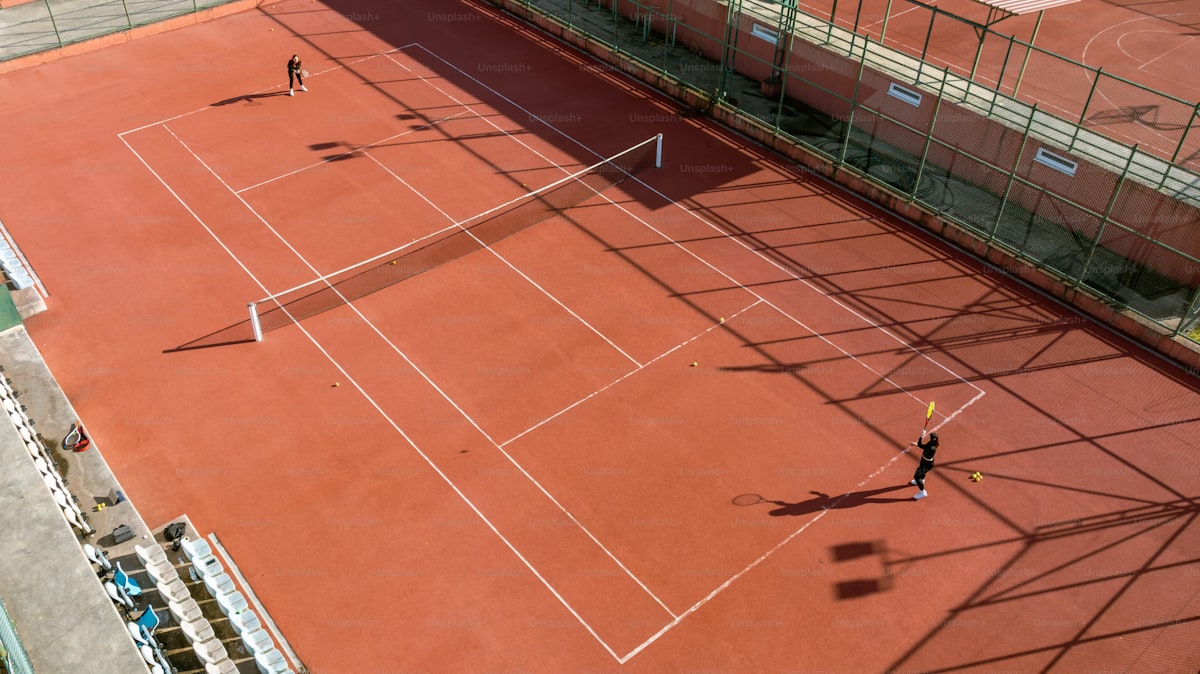
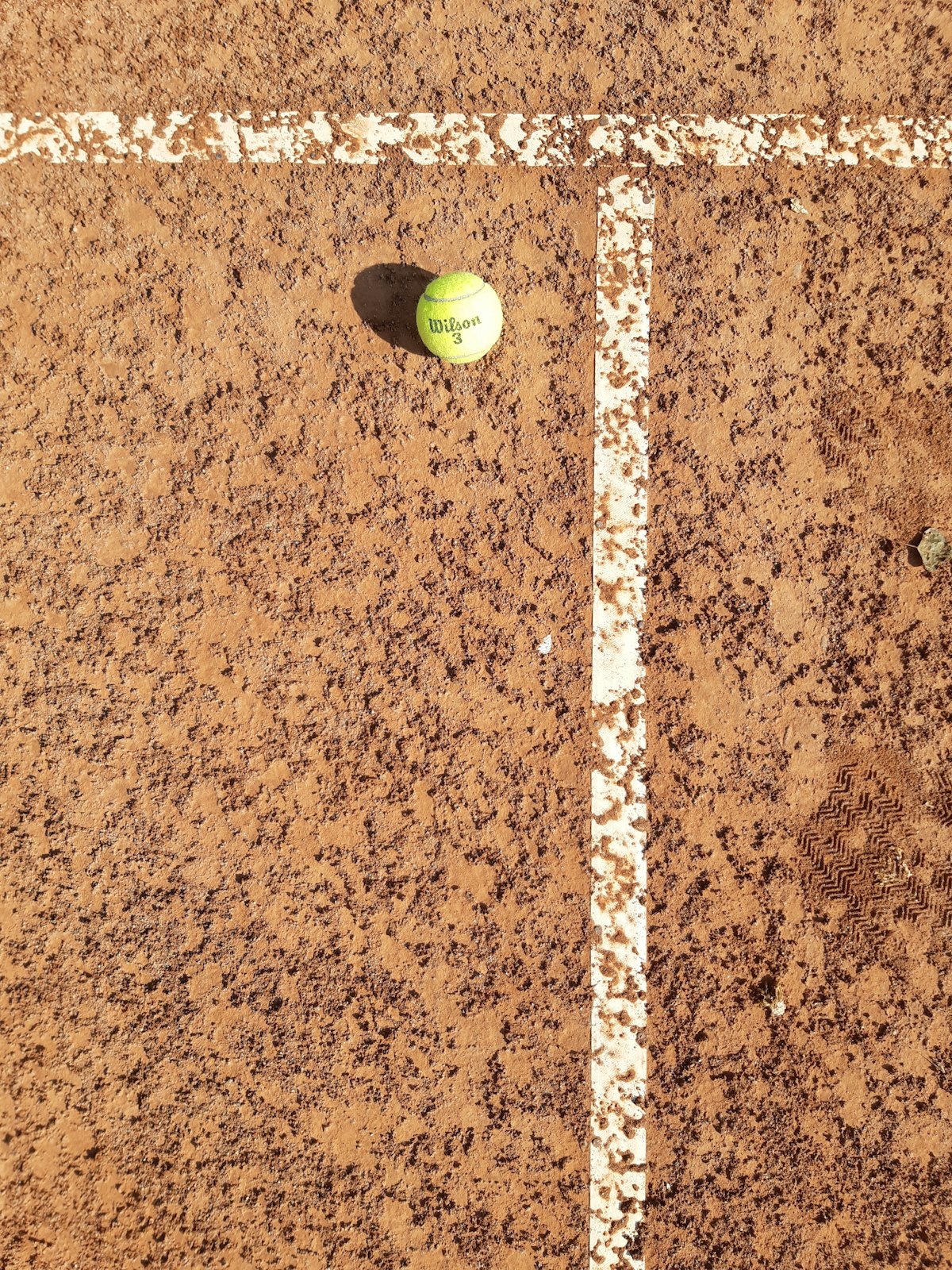
The surface matters too. Hard courts, clay courts, and grass courts each play very differently. Hard courts (like those at most US public parks) bounce true and play fast. Clay courts slow the ball and produce a higher bounce — more forgiving on joints but requiring more patience. Grass courts are rare outside private clubs and play very fast with a low bounce.
Basic Rules and Scoring
Tennis scoring is famously strange. Here's how it actually works.
Scoring Within a Game
Each game is played from 0 (called "love") and progresses through four points:
| Points Won | Score |
|---|---|
| 0 | Love |
| 1 | 15 |
| 2 | 30 |
| 3 | 40 |
| Win | Game |
Nobody knows for certain why the scoring jumps 15, 15, then 10. The most plausible theory traces it to medieval French clock-face scoring, but it's mostly just tradition at this point.
When both players reach 40, the score is called deuce. From deuce, one player must win two consecutive points to take the game. The first point won after deuce gives that player advantage ("ad-in" if the server has it, "ad-out" if the returner has it). Win the next point and you win the game. Lose it and the score returns to deuce.
Games, Sets, and Matches
A set is won by the first player to win 6 games, provided they lead by at least 2 games. If it reaches 6–6, most formats play a tiebreak — a special game played to 7 points (win by 2), where points count as 1, 2, 3, and so on.
A match is typically best of 3 sets (first to win 2) in recreational and amateur play. Grand Slam men's matches use best of 5.
A complete score might look like: 6–3, 4–6, 7–5 — meaning the winner took the first set 6 games to 3, lost the second 4–6, then won the third 7–5.
Who Serves When
Players alternate serving entire games. The server stands behind the baseline on the right side (deuce court) for the first point, then the left side (ad court) for the second, continuing to alternate. A fault (missed serve) gives you one more attempt. Two consecutive faults is a double fault — you lose the point.
Tip: In your very first sessions, don't stress the full scoring system. Play "first to 4 points wins the game" or just rally and count consecutive shots in a row. Pure rallying is more useful than match play at the very beginning.
The Four Essential Strokes
You don't need to master all of these before your first match, but understanding what they are gives you a mental framework.
Forehand
The forehand is almost always the first stroke beginners develop. It's hit with your dominant hand on the side of your body — a sweeping motion from low to high that generates topspin (forward rotation on the ball that pulls it down into the court).
Basic technique: Start with your racket back, pointing toward the back fence. Step into the ball with your non-dominant foot. Swing low to high, brushing the back of the ball upward. Follow through until the racket finishes on the opposite shoulder. Contact should happen in front of your body, not beside it.
Don't try to crush the ball early on. The goal is a smooth, repeatable swing — power follows technique, it can't be forced.
Backhand
The backhand is hit on the opposite side of your body. You can hit it one-handed or two-handed. Most beginners find the two-handed backhand easier to control because the non-dominant arm adds stability.
Two-handed technique: Both hands grip the racket. Turn your shoulders so your back is almost facing the net. Swing through the ball, keeping both hands on the racket through contact, finishing with the racket up near your left shoulder (for right-handers).
Serve
The serve starts every point and is the one stroke where you have complete control — no one is hitting the ball at you.
Basic technique: Stand sideways behind the baseline, left foot forward (for right-handers). Toss the ball slightly in front and above your hitting shoulder. As the ball rises, drop your racket behind your back (the "trophy position"), then swing up and through at full arm extension. Pronate your wrist as you make contact. Follow through across your body.
A consistent, reliable serve is more valuable than a fast one at the beginner level. Aim for the service box rather than trying to ace anyone.
Volley
A volley is any ball you hit before it bounces — usually played close to the net. It's not a full swing; it's a short, punching motion that redirects the ball.
Basic technique: Hold your racket out in front of you. When the ball comes, step toward it and block or punch with a compact motion. You're not trying to generate power — just control the angle. Keep your eyes on the ball, not the court.
Beginners don't need to volley much. The baseline is a safer place to learn. But understanding the volley matters because doubles play relies heavily on net positioning.
Singles vs Doubles Play
Singles is one player against one player. It's more physically demanding — you cover the entire court alone. Singles rewards consistency, fitness, and smart shot placement.
Doubles is two players on each side. The wider court (using the alleys) is in play. Doubles is generally more social, less exhausting, and a better format for beginners because there's always a partner to cover for you. Net positioning and communication matter more than raw power.
Most beginners find doubles more immediately enjoyable. You touch the ball less often, the pressure is shared, and rallies tend to be more forgiving. As you develop your game, both formats are worth playing.
Tennis Etiquette Basics
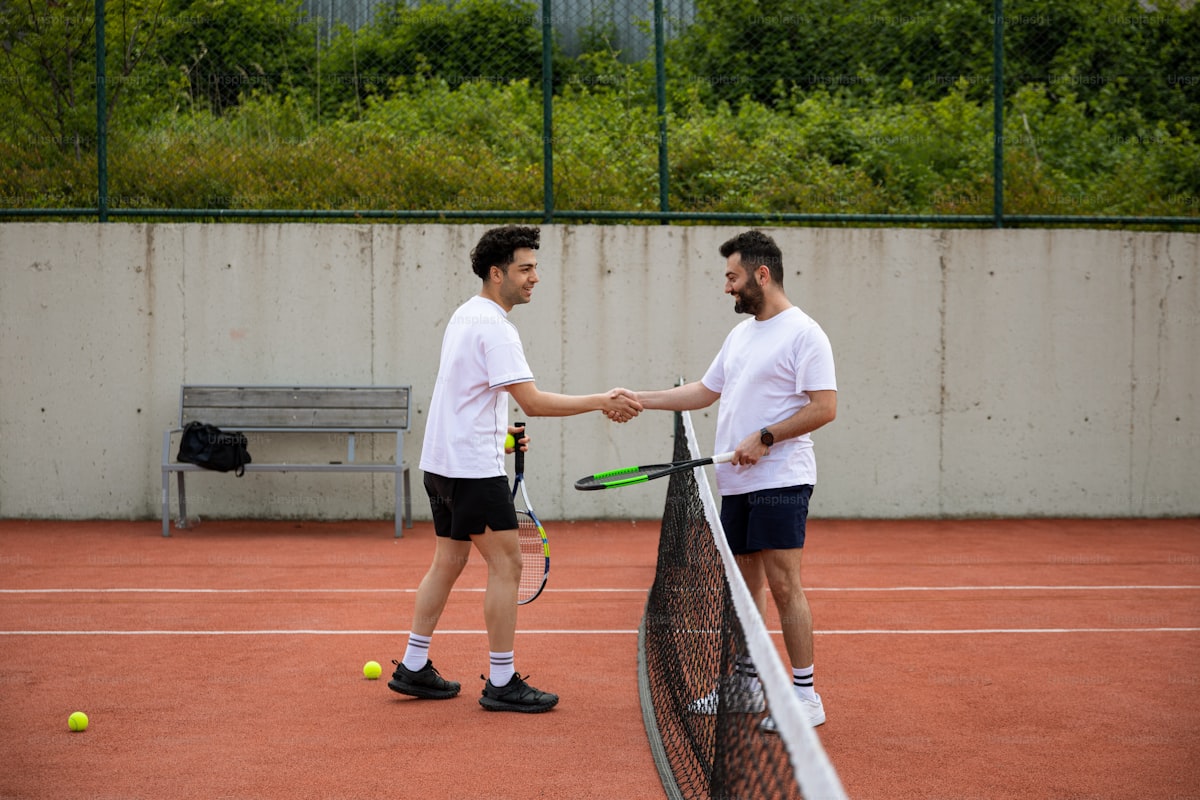
Tennis has a set of unwritten rules that every player is expected to know from day one. A few critical ones:
- Call your own lines honestly. In recreational play without a chair umpire, players call balls in or out on their side. If you're not sure, the ball is in. Never call a ball out to win a point you're uncertain about.
- Don't walk behind a court mid-point. Wait for the point to finish before crossing behind players.
- Return opponent's balls promptly. Don't make someone chase balls across three courts.
- Quiet during points. Applaud good shots, but don't shout or play music loud enough to disrupt adjacent courts.
- Shake hands (or tap rackets) after the match. It's expected, win or lose.
For a thorough breakdown of both the written and unwritten rules, read our full tennis etiquette guide.
How to Find Courts Near You
Public tennis courts are more common than most people realize. City parks, recreation centers, schools, and HOA facilities all tend to have them — and the majority are free to use on a first-come, first-served basis. Our guide to finding tennis courts near you covers the best methods for locating courts in your area.
Tips for Your First Match
These are the things nobody tells beginners but that actually matter:
Warm up before you compete. Spend 5–10 minutes rallying from the baseline before you try to play a set. This isn't just injury prevention — your shots will be sharper, your footwork will feel better, and your nerves will settle. Start closer to the net and work your way back.
Don't try to hit the ball hard. This is the single biggest mistake beginners make. Swinging harder generates errors, not winners. Focus on a smooth, controlled swing that gets the ball over the net with room to spare.
Aim for the middle of the court. High balls over the center of the net give you the most margin. Trying to rip winners down the line before you've learned to keep the ball in play is how beginners spend most of their time picking up balls.
Focus on the ball, not the court. Watch the ball all the way to your strings. Most beginner errors come from looking up too early to see where the shot is going.
Expect to miss — a lot. Even good players miss. Research from Harvard and professional match stats consistently show that even tour players win only about 55% of points against each other. The goal is not to be perfect; it's to learn what your errors have in common and address them one at a time.
Next Steps
Once you've played a few times and caught the tennis bug, here's how to keep developing:
Take a lesson or two. A single lesson with a teaching pro can fix a technical flaw that would take months to self-diagnose. Most parks and recreation departments offer affordable group lessons for adults.
Join a USTA league. The USTA runs a nationwide recreational league system using a skill rating called NTRP (National Tennis Rating Program), running from 1.0 (complete beginner) to 7.0 (professional). Adult league play is organized by skill level so matches are competitive and fair.
Find a hitting partner. Progress accelerates when you play regularly. Apps like Tennis Pal, Meetup, or your local club's bulletin board are good places to find players at your level.
Watch professional tennis. Watching high-level play trains your eye for what good tennis looks like. The Australian Open, French Open, Wimbledon, and US Open are the four Grand Slams — all broadcast widely. You'll start seeing the game differently.
Curious how tennis compares to pickleball? If you have friends who play both, check out our breakdown of tennis vs pickleball to understand the key differences before you choose a main game.
Tennis rewards patience. The first month is about getting the ball over the net. The first year is about building consistency. But from the beginning, every session on the court is time well spent.
Find a Court to Start Playing
The hardest part of starting tennis is just showing up. Browse popular cities to find a court near you:
New York · Los Angeles · Chicago · San Diego · Houston · Atlanta · Phoenix · Boston
Or browse all tennis courts by state — search by city to see nearby courts, surface types, and amenities like lighting.
Sources
- British Journal of Sports Medicine — Leisure-time physical activity and mortality (2017) — Study of 80,000 adults finding racket sports associated with 47% lower cardiovascular mortality risk
- USTA — Official website — League information, NTRP rating system, and adult recreational programs
- USTA "The Code" — Players' Guide to Fair Play (PDF) — Honor-system guidelines for line calls, scoring, and conduct on courts without officials
- ITF Rules of Tennis — Official rules including scoring, service faults, and court dimensions
- Harvard Health — Tennis and cardiovascular health — Research on tennis as a lifetime sport and its health benefits
Written by the team at Tennis Count, a free court discovery platform built by tennis and pickleball players for tennis and pickleball players. We write from firsthand playing experience to help you find the best courts and make the most of your time on them.