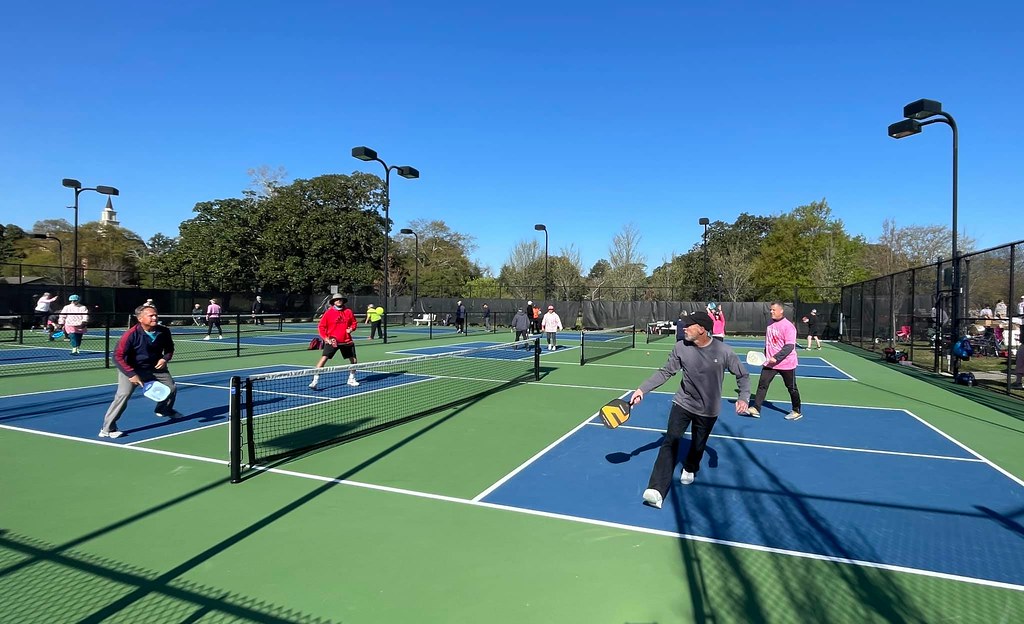
Pickleball is no longer a novelty. The Sports & Fitness Industry Association counted 13.6 million U.S. players in 2023 — a figure that had more than tripled in three years — and participation has continued climbing through 2025. Courts are going in at parks, fitness clubs, rooftops, brewery patios, and repurposed warehouses. Every metro has a pickleball story now.
But having courts is not the same as having a scene. A real pickleball city has dedicated clubs where open play runs from morning until close, public courts with enough density that strangers actually show up, organized leagues, tournaments that pull regional players, and — ideally — weather that lets people play year-round. Those are different things, and most cities excel at only some of them.
This list ranks the ten U.S. cities that have actually built all of it. It is not a population ranking, and it is not a ranking of which cities have the most courts on paper. It is a ranking of which cities, in 2026, have the deepest pickleball ecosystems for a player who wants to show up tomorrow and find a game.
How We Ranked Them
Five factors went into the ordering: number of dedicated pickleball facilities, public court density relative to population, tournament hosting and sanctioned events, active leagues and open-play community, and climate suitability for year-round outdoor play. We weighted dedicated indoor clubs more heavily than a pure climate ranking would suggest, because indoor facilities are the clearest signal that a market has moved past the backyard phase into a real recreational economy. That bias is worth disclosing. If climate alone decided the list, Florida, Arizona, and Southern California would fill the top five and the Mountain West would be absent. Reality is more interesting than that.
1. Phoenix, Arizona
Phoenix is the most complete pickleball city in America right now, and the reasons stack on top of each other. The metro offers year-round outdoor play thanks to its dry desert climate, a massive retiree population that has driven recreational demand for two decades, and one of the densest concentrations of dedicated pickleball facilities in the country. Sun City, just northwest of Phoenix, is frequently cited as one of the earliest adult communities to adopt the sport en masse, and that infrastructure has spilled outward into Scottsdale, Mesa, and the broader Valley of the Sun. Pickle City Scottsdale and a growing roster of dedicated clubs have turned the metro into a destination for competitive players.
The standout public venue is Encanto Sports Complex at 2121 N 15th Ave, a large municipal facility that holds a 4.6-star rating across hundreds of reviews and regularly hosts league play. What sets Phoenix apart is not any single facility but the sheer number of options within a 30-mile radius — dedicated indoor clubs, converted public courts, retiree community courts, and tournament venues, all operating year-round.
2. Tampa, Florida
Florida's Gulf Coast is the closest thing American pickleball has to a permanent professional hub. Naples is often named the pickleball capital of the United States — the US Open Pickleball Championships have been held at East Naples Community Park since 2016 — and the ecosystem radiates north through Fort Myers, Sarasota, and into the Tampa Bay region. Tampa itself has leaned into the sport: waterfront courts, dedicated clubs, and tournaments nearly every weekend across the metro.
Tampa Pickleball Crew at 1701 E 2nd Ave is a standout, with a 4.8-star rating and a reputation for running some of the best-organized open play in the state. The Florida scene also has a tournament culture that other regions have not matched, with league nights functioning as something closer to amateur athletics than weekend recreation. Humidity is a factor from June through September, but indoor clubs across the metro absorb most of the year-round demand.
3. Austin, Texas
Austin is where pickleball's professional-class demographic shows up most clearly. The tech corridor, a player base that skews younger than the national average, and a city government willing to convert underused tennis courts have combined to produce one of the most aggressive pickleball buildouts in any major metro. Austin Pickle Ranch and a wave of dedicated clubs have opened in the last three years, and public facilities around the city see constant weeknight rotations.
The standout is Urban Pickleball Club at 300 San Antonio St — a downtown facility with a 4.7-star rating that draws a noticeably younger crowd than you'll find at most indoor clubs. Austin also benefits from a long shoulder season. October through April offers nearly perfect outdoor pickleball weather, which is why you will see tournament brackets running almost every weekend from fall through spring.
4. Denver, Colorado
Colorado's pickleball growth is the Mountain West's most visible expansion story. Denver has invested in public court conversions, and the Front Range is stacked with dedicated facilities serving Boulder, Fort Collins, and Colorado Springs as well as the city proper. Winter pushes most play indoors, but the density of indoor clubs makes that a non-issue — if anything, the indoor culture has strengthened the community, since the same rotating group of players sees each other every week from November through March.
Mile Hi Pickleball at 3700 Havana St is a standout, with a 4.7-star rating and one of the better competitive ladders in the region. Denver's altitude adds a genuine wrinkle: the ball carries noticeably farther at 5,280 feet, which takes visiting players a few games to adjust to. Locals know the effect well and will mention it — sometimes helpfully, sometimes as a light-handed excuse.
5. Seattle, Washington
Seattle earns its spot for a reason that has nothing to do with climate: pickleball was invented on Bainbridge Island, Washington, in 1965, by Joel Pritchard, Bill Bell, and Barney McCallum. That origin story is codified by USA Pickleball and well-documented across mainstream sports coverage. The Puget Sound region has leaned into that heritage, with a museum-like reverence for the game's roots and a persistent effort to keep the sport's founding story tied to its founding geography.
The practical scene is strong too. Picklewood Paddle Club at 4121 1st Ave S runs a tight operation with a 4.9-star rating, and indoor clubs throughout the metro fill the gap during the Pacific Northwest's long gray stretch. Seattle's public courts tend to be converted tennis facilities with shared lines, which is fitting given that the city hosts one of the most tennis-literate populations in the country.
6. Nashville, Tennessee
Nashville's pickleball scene reflects the city's broader trajectory: rapid growth, heavy in-migration, and a willingness to build new recreational infrastructure quickly. Nashville has a growing network of dedicated clubs and some of the most heavily used public courts in the Southeast. Centennial Sportsplex, one of the city's flagship municipal facilities, carries more than 800 user reviews on Google — an unusual level of public engagement that suggests genuine daily traffic rather than a handful of evangelists.
The standout is Dinkville at 1001 Broadway, a downtown dedicated facility with a 4.7-star rating that has become a regular stop for visiting players. Nashville also benefits from a tourism economy that has pulled pickleball into the hospitality sector — hotels, bachelorette parties, and corporate retreats are booking courts, which has funded the private facility boom without draining the public side.
7. San Diego, California
Coastal Southern California is an obvious fit for pickleball, and San Diego has the most complete scene south of Los Angeles. Year-round outdoor weather, a strong tennis heritage that translated smoothly into pickleball conversion, and an active public parks system have combined to put courts almost everywhere. Balboa Park Activity Center anchors the city's public offering, and dedicated clubs have opened across North County and in neighborhoods like Little Italy and North Park.
Little Italy Pickleball Court at 1747 Pacific Hwy is the standout, with a 4.9-star rating and a compact footprint that has become a model for urban pickleball elsewhere. San Diego's scene has a noticeably relaxed social tone — less competitive intensity than Phoenix or Tampa, more walk-up play, more mixed-skill games. That may or may not be what you are looking for, but it is real.
8. New York, NY
Urban pickleball is a different animal, and New York has done more with less space than any other U.S. city. Rooftop facilities, converted industrial spaces, and creative indoor conversions have given Manhattan, Brooklyn, and Queens a surprisingly deep bench of venues. CityPickle, which runs a network of locations across the city, has been one of the most-covered pickleball operators in mainstream media.
The flagship is CityPickle Times Square at 1501 Broadway, a 4.9-star indoor facility that is as much a tourism story as a local one — visiting players frequently stop in, and the ambient pace of the venue reflects that. New York's public courts are limited but heavily used; dedicated pickleball spaces in McCarren Park and Central Park have waitlists nearly every evening in warm weather. The scene here is about density, not acreage.
9. Charlotte, North Carolina
Charlotte is the clearest example of a regional trend: combining pickleball with food and beverage. The "eatertainment" model — pickleball venues that double as restaurants, bars, or event spaces — has taken hold across the Southeast, and Charlotte has become its capital. Tipsy Pickle at 201 Camp Rd is the standout, carrying a 4.8-star rating across more than 800 reviews and running what is effectively a restaurant with pickleball courts attached.
The format is divisive among purists. Players who want a hushed competitive environment sometimes bristle at the music, the food smells, and the casual atmosphere. But the model has brought new players into the sport at a rate that traditional clubs have not matched, and Charlotte's public parks system has kept pace with the demand. Courts in Matthews, Huntersville, and Ballantyne have filled in the serious-play side of the scene.
10. Salt Lake City, Utah
Utah is a pickleball hotbed, and it has been for longer than most coastal observers realize. The Picklr, one of the fastest-growing indoor pickleball franchises in the country, was founded in Utah and remains headquartered there. Salt Lake City and its surrounding metro now feature multiple Picklr locations along with independent clubs and an unusually active public-parks scene. The Mormon Belt's early adoption of pickleball has been well-documented in regional news coverage for years.
The Picklr Salt Lake City at 1180 Brickyard Rd is the natural flagship. Its 4.2-star rating is lower than several venues higher on this list, partly because the facility processes such a high volume of players that minor complaints accumulate more visibly. The broader point is the same: Utah plays a lot of pickleball, the leagues are serious, and the climate — though seasonal — pushes demand indoors rather than suppressing it.
Honorable Mentions
A few cities came close. Las Vegas has exploded as a tournament destination and could plausibly crack the top ten in a future update once its public-court density catches up with its private facilities. Sacramento has one of the strongest open-play cultures in California and would rank higher if its dedicated club count matched Phoenix or Austin. Atlanta's scene is growing fast, particularly in the northern suburbs, and the city's tennis-to-pickleball conversion rate has been among the highest in the country. Chicago punches above its weather-limited weight thanks to a dense network of indoor facilities. Charleston, South Carolina is quietly building one of the most charming small-metro scenes in the Southeast, with a growing cluster of waterfront and downtown venues.
Any of those five could be argued into the top ten, and a reader from any of them would be right to push back. This is a list, not a final verdict. Pickleball is moving too quickly for a 2026 ranking to still be accurate in 2028.
If your city did not make the list, or if the one that did is not quite what you wanted, you can browse every US pickleball city we cover to see what's actually available near you. And if you are still deciding whether pickleball is even the right sport — whether to pick up a paddle or stick with a racket — our tennis vs. pickleball comparison walks through the honest tradeoffs between the two.
Written by the team at Tennis Count, a free court discovery platform built by tennis and pickleball players for tennis and pickleball players. We write from firsthand playing experience to help you find the best courts and make the most of your time on them.